Flora in Jhalana Leopard Reserve is fundamentally a story of survival — botanical survival in a hostile arid environment, and the survival of a wildlife reserve against the encroachment of one of India's fastest-growing cities. Covering just 23 sq. km of the Aravalli hill range within Jaipur's urban boundary, Jhalana supports a vegetation community shaped by three forces: geological antiquity, extreme aridity, and — uniquely — decades of invasive species colonisation that has paradoxically strengthened rather than destroyed the reserve's ecological function.
The reserve's vegetation belongs to the northern tropical thorn forest category, one of India's most drought-adapted biomes. Thin, rocky Aravalli soils — some of the oldest exposed geology on Earth at over 3.5 billion years — hold very little water after the brief monsoon season. Plants here have evolved or self-selected over centuries for deep root systems, small or compound leaves that minimise water loss, thorny armour that discourages browsing, and the ability to shed leaves entirely during the dry season to conserve energy. The dominant native canopy tree, Dhok (Anogeissus pendula), is perhaps the master of this adaptation, colonising steep rocky slopes where no other large tree can establish.
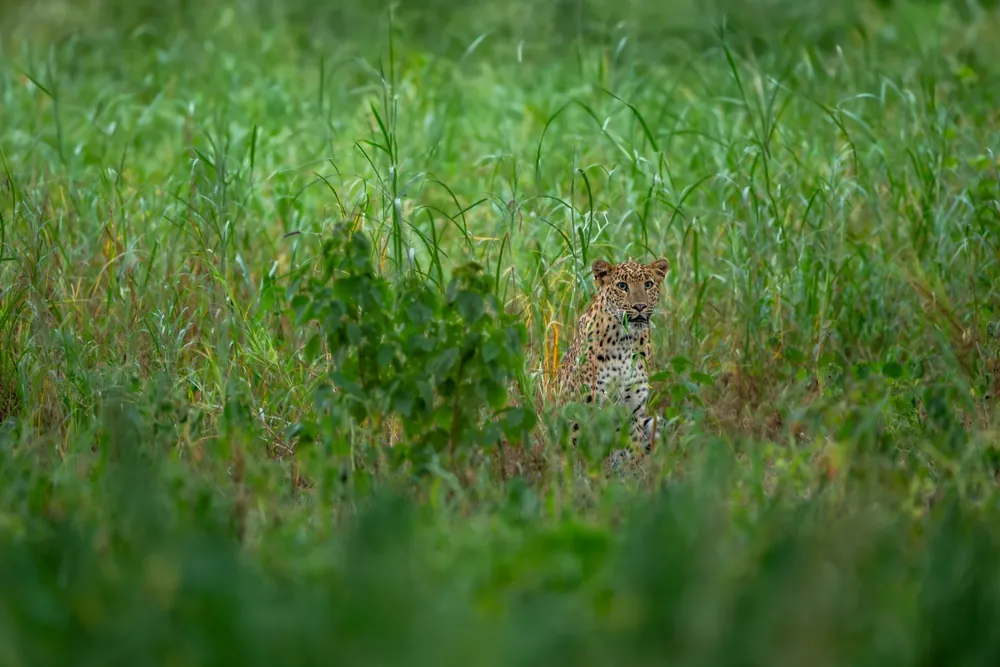
Jhalana's vegetation zones follow the terrain closely. The upper ridges and rocky outcrops are sparsely wooded with Dhok, its grey-barked canopy providing structural habitat and resting perches for leopards and raptors. Mid-slopes carry a denser mix of Dhok, Khejri, Babul, and Ber — the thorny, multi-species scrubland that defines the arid Aravalli landscape. Valley floors and nullah margins are the most vegetatively diverse areas: Rohida, Palash, and seasonal herbs concentrate here where soil depth and occasional moisture allow richer plant communities. It is in these valley zones that the park's highest prey density — nilgai, sambar, cheetal, and wild boar — is found, making them prime leopard hunting terrain.
The seasonal cycle of flora in Jhalana Leopard Reserve is compressed but dramatic. After the June–September monsoon, the reserve transforms rapidly: grasses spring up across bare rocky patches, Dhok pushes new leaf growth, seasonal herbs and wildflowers erupt from the soil, and the nullah channels run with water that sustains moisture-dependent plants along their margins. By October–November, this flush of green begins to fade, but the reserve is at its most comfortable and visually rich — ideal conditions for leopard safaris. Through the dry winter and into summer, the vegetation progressively thins and browns. By May and June, most deciduous trees are bare, the grass is bleached and dry, and the Juliflora thickets — being semi-evergreen — stand out as the dominant green structure in the landscape.
The conservation story of flora in Jhalana Leopard Reserve is inseparable from the story of Prosopis juliflora — Juliflora or Vilayati Kikar. Introduced across Rajasthan in the 1960s and 1970s as a fast-growing solution to fuel shortages and bare hillside degradation, it spread across the Aravalli with extraordinary speed, outcompeting native Dhok and Khejri regeneration. In Jhalana, it now occupies a significant fraction of the reserve's mid-slope vegetation. Yet its removal presents a genuine ecological dilemma: the dense Juliflora thickets have become the primary denning and cubbing habitat for Jhalana's leopards, and rapid clearance could disrupt breeding cycles. Current conservation thinking favours gradual, phased removal of Juliflora with simultaneous replanting of native Dhok, Khejri, Rohida, and Ber — a restoration arc measured in decades rather than seasons.
Dhok Anogeissus pendula
Native Canopy
Dhok is the true native soul of Jhalana's vegetation — the tree that was here before the city grew around it, before the invasive Juliflora arrived, and before the reserve received its protected status. Anogeissus pendula is a medium-sized deciduous tree instantly recognisable by its smooth, silver-grey bark and the characteristic drooping — pendulous — tips of its branches, an adaptation that reduces wind stress on exposed Aravalli ridges. In Jhalana, Dhok is found primarily on the upper slopes and ridge crests where the soil is thinnest and the sun most relentless. Its deep, exploratory root system follows fracture lines in the ancient Aravalli rock, extracting moisture from depths that most plants cannot reach. This drought tolerance is not just survival — it is ecological infrastructure. Dhok's canopy, however open and sparse compared to the jungles of central India, provides the only significant overhead shade in a reserve where afternoon summer temperatures regularly exceed 42°C. Under this canopy, leopards rest through the midday hours, invisible from the jeep track below. The bark of Dhok supports a community of bark-feeding insects — beetles, moth larvae, and spiders — that in turn feed the reserve's birds, creating a food web from rock to raptor within the span of a single tree. Dhok's leaf litter, decomposing slowly in the dry heat, builds the thin humus layer that allows other plant species to establish in its shadow, making it a nurse tree for the reserve's native vegetation recovery.
Khejri Prosopis cineraria
Sacred Native
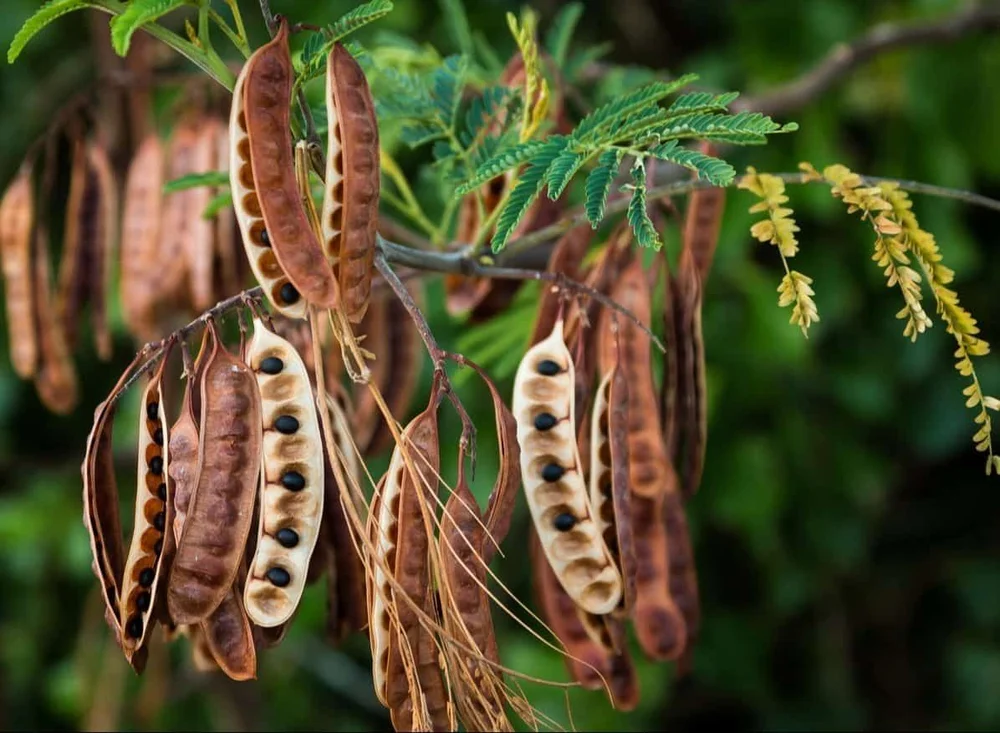
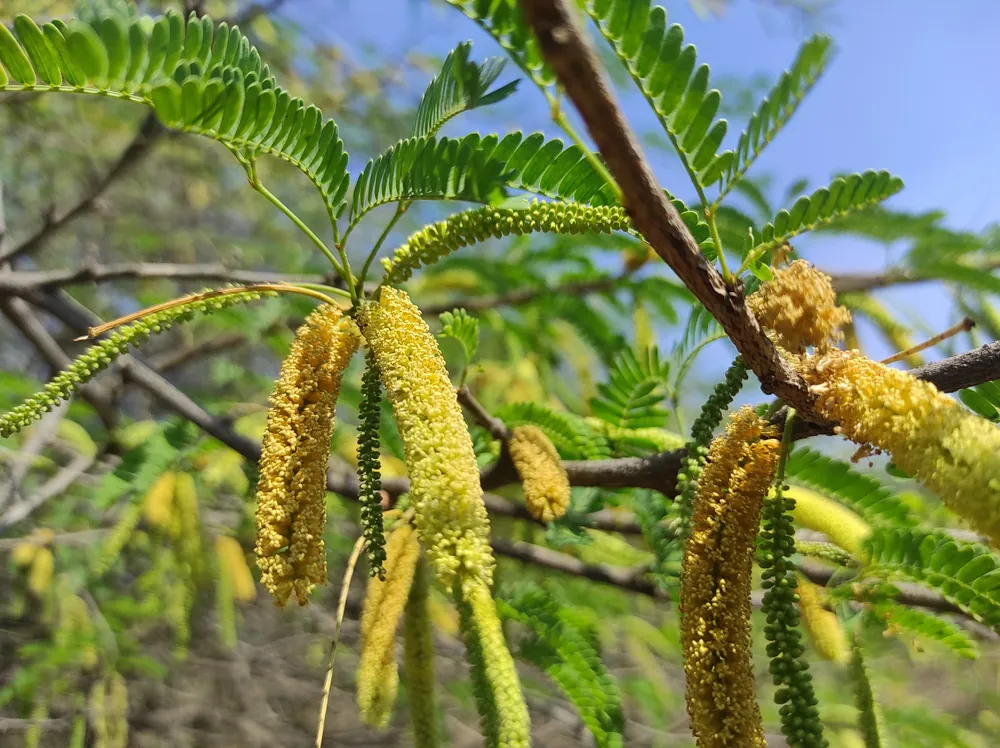
Khejri — Prosopis cineraria — holds a place in the cultural and ecological landscape of Rajasthan that no other tree can match. It is the official state tree, the subject of one of Indian history's most remarkable acts of ecological sacrifice (the 1730 Bishnoi martyrdom of 363 people who died protecting Khejri trees from felling), and one of the most ecologically versatile trees of the Indian arid zone. In Jhalana, Khejri occupies the drier, more open patches between rocky outcrops and along the reserve's peripheral slopes, where even Dhok thins out. Its feathery, bipinnate leaves are an evolutionary masterpiece of water conservation — maximising photosynthetic surface area while minimising the large leaf area through which water evaporates in desert heat. Uniquely among the trees of Jhalana, Khejri is also a nitrogen-fixing legume: bacteria in nodules on its roots convert atmospheric nitrogen into soil-available nutrients, enriching the thin Aravalli soil for every plant species growing in its vicinity. This soil-building function makes Khejri a foundational species for the reserve's long-term vegetation recovery, particularly in areas where Juliflora removal is creating bare ground that needs native re-establishment. Its seed pods — sangri — are an important food source for nilgai, wild boar, and migratory birds passing through Jaipur. The Khejri in Jhalana are living links to the Aravalli's pre-urban ecology, remnants of a vegetation community that once covered far more of this landscape.
Juliflora Prosopis juliflora
Invasive Dominant
Prosopis juliflora — Juliflora, Vilayati Kikar, or Mexican Mesquite — is the most ecologically controversial plant in Jhalana's landscape. Native to South America and the Caribbean, it was introduced to India in the colonial era and aggressively planted across Rajasthan from the 1960s onwards as a solution to fuel shortages, soil erosion, and bare hillside degradation. In Jhalana, it spread across the degraded Aravalli hillsides with extraordinary vigour, its water-seeking roots penetrating deep into rocky fractures, its thorny multi-stem growth form outcompeting native shrubs for light, and its allelopathic root chemicals suppressing the germination of competing plants around it. By the time Jhalana received formal wildlife reserve status, Juliflora was already dominant across significant portions of the mid-slope vegetation. What followed is one of conservation biology's most intriguing case studies: despite being an invasive outsider, Juliflora's dense, thorny, low thickets have become the primary habitat structure used by Jhalana's leopards for concealment, movement, denning, and cub-rearing. Female leopards with cubs are most frequently detected within or at the edge of Juliflora thickets. The thorny interior of a mature Juliflora stand is effectively impenetrable to humans and most large animals, creating a degree of security that no native scrub species currently provides at the same density. This creates a genuine conservation paradox that Jhalana's managers and ecologists continue to navigate — one that makes flora in Jhalana Leopard Reserve one of the most thought-provoking case studies in urban wildlife conservation in India.
Other Tree Species in Jhalana Leopard Reserve
The supporting botanical community of Jhalana, though less celebrated than its leopards, is a finely adapted collection of arid-zone specialists that collectively sustain the reserve's food web. Babul Acacia (Vachellia nilotica) is among the most important of these — a thorny, flat-topped tree common across Rajasthan's dry landscapes that provides structural cover for small prey species including hares, mongoose, and jungle cats, all of which are part of Jhalana's leopard prey base. Its bright yellow, ball-shaped flowers bloom in spring, attracting bees and butterflies that contribute to the reserve's pollinator diversity, and its seed pods are eaten by birds and ungulates through the dry season.
Ber (Ziziphus mauritiana) is one of Jhalana's most ecologically productive fruit trees, producing small, round fruit in winter and early spring that draws a wide range of frugivores — grey francolins, peacocks, nilgai, and wild boar — into the more open areas of the reserve. This fruit-based congregation of prey species in the Ber-fruiting zones is one of the ecological triggers that makes winter the most rewarding season for leopard sightings. Rohida (Tecomella undulata) — sometimes called Desert Teak and the source of Rajasthan's state flower — appears in Jhalana's valley floors and nullah margins, its brilliant orange-gold trumpet flowers one of the most spectacular botanical events in the reserve during February and March. Palash (Butea monosperma) likewise blooms orange-red in early spring, adding seasonal colour to the otherwise grey-and-brown winter landscape.
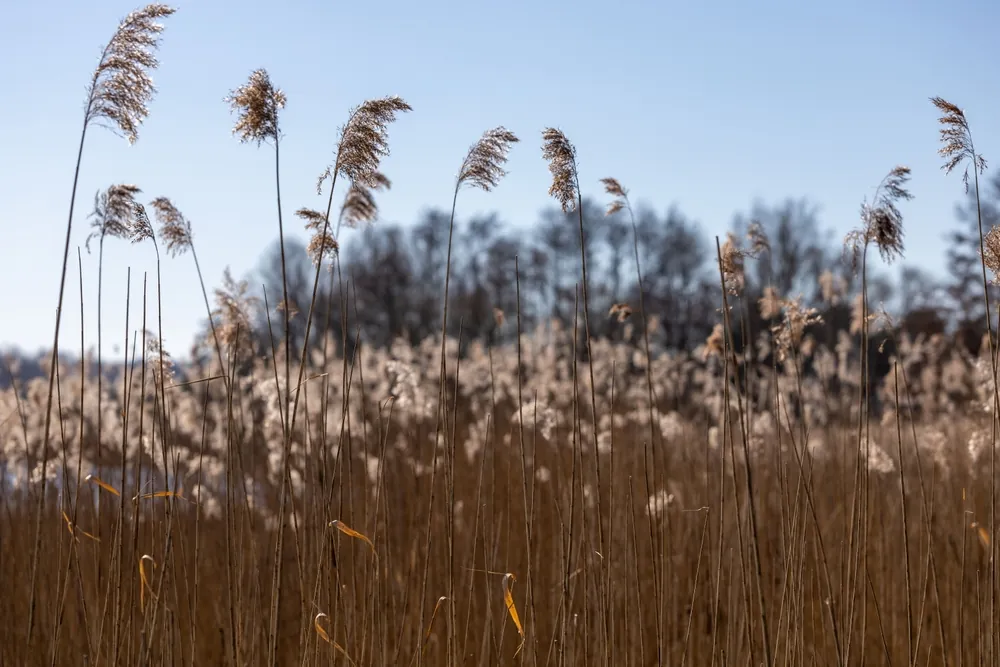
Aak or Calotrope (Calotropis procera) occupies the most degraded, disturbed patches of the reserve — rocky clearings and track edges — its large, waxy, pale green leaves and purple-white flowers making it distinctive. Though considered a weed, Aak is an important pollinator plant and a food source for specialist insects including the Plain Tiger butterfly, which breeds exclusively on it. Kair (Capparis decidua) is a leafless, thorny succulent shrub of the driest rocky patches, its vivid red berries providing food for birds and small mammals in summer when little else is available. Dub grass (Cynodon dactylon) carpets the reserve's open rocky patches after monsoon rains, providing the grazing substrate that sustains nilgai, wild boar, and hare populations — and through them, the leopards that hunt them. The presence of even this modest, resilient grass layer is a marker of ecological health in an urban reserve under constant pressure. Together, these species make flora in Jhalana Leopard Reserve not a simplified urban green patch but a genuinely functioning, multi-layered arid ecosystem — compact, stressed, and extraordinary.